Case Study
Axle Health
Built full-stack product improvements for a home healthcare logistics platform focused on scheduling reliability, operational visibility, and scalable care-delivery workflows.
Screenshots
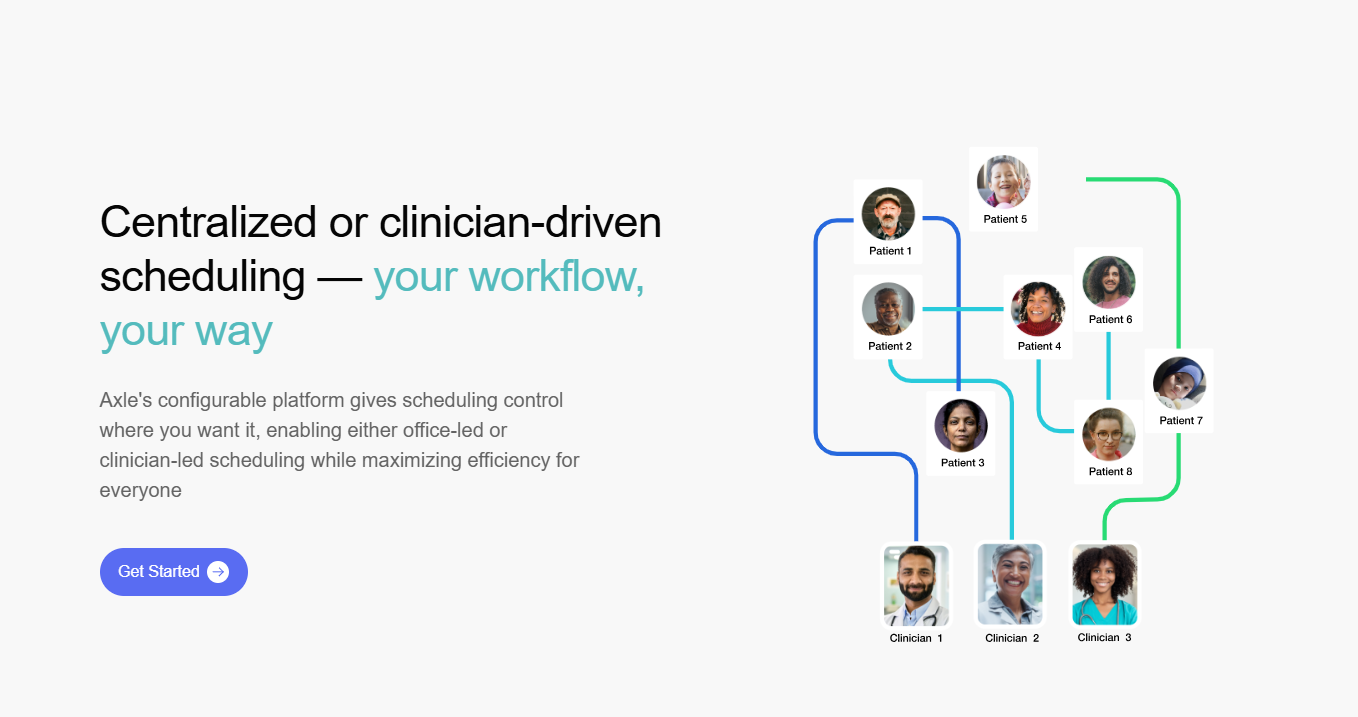
Axle Health clinician-driven scheduling interface
Axle Health
Senior Full-Stack Engineer • Contract
Enterprise-grade logistics platform for in-home care operations
Worked on a high-complexity scheduling and coordination system used by care teams managing real-world patient visits. The product sits at the intersection of logistics, healthcare, and operations, where reliability matters more than anything.
Key Outcomes
- Improved consistency across scheduling and operations workflows.
- Reduced friction for coordinators managing multi-visit, real-world logistics.
- Strengthened frontend/backend contract reliability in workflow-heavy systems.
- Helped establish a more scalable foundation for future automation and analytics.
Client
Axle Health operates in a space where software directly impacts real-world care delivery. Their platform focuses on scheduling, route optimization, patient engagement, and operational visibility for in-home healthcare providers.
As demand scaled, the system needed to remain flexible without becoming unpredictable — something that’s easier said than done in logistics-heavy products.
I joined to support product and engineering initiatives focused on improving reliability, clarity, and scalability across core workflows.
Contributions
Most of my work sat at the intersection of frontend workflows and backend orchestration.
One of the first things I noticed was how sensitive the system was to small inconsistencies — especially in scheduling and workflow transitions. In a product like this, a minor mismatch between UI and backend logic can cascade into real operational confusion.
I focused on tightening that layer:
- Improved behavior across key workflow handoffs between scheduling and operations.
- Strengthened API and UI contract alignment to reduce ambiguity in critical flows.
- Contributed to backend services handling scheduling logic and workflow orchestration.
- Supported async/background processes for handling operational events and exceptions.
On the frontend side, I worked with React + TypeScript, building internal tooling used by coordinators who rely on speed and clarity to do their jobs.
On the backend, I worked within a Node.js + AWS environment, supporting services that needed to be predictable under real operational load.
Challenges
1. Scheduling is not just CRUD
This wasn’t a simple calendar system. Scheduling involved:
- geography and routing
- clinician availability
- time windows and constraints
- last-minute changes and exceptions
Even small inconsistencies could break downstream workflows. The challenge was keeping the system flexible while still behaving predictably.
2. Frontend / backend alignment
In a workflow-heavy system, the UI is only as good as the backend contracts behind it.
There were cases where:
- the UI assumed one behavior
- the backend responded differently under edge conditions
Fixing this wasn’t about rewriting everything — it was about tightening contracts and making system behavior more explicit and reliable.
3. Scaling without overengineering
As the product evolved, there was a constant tension between:
- adding new workflow capabilities
- keeping the system maintainable
The goal wasn’t to introduce complex architecture — it was to make practical improvements that actually reduced operational risk.
4. Healthcare-grade expectations
Even though this wasn’t a clinical system, it still lived in a domain that requires:
- strong reliability
- clear permissions and access control
- integration readiness (EMRs, APIs, etc.)
Engineering decisions had to reflect that level of trust.
Accomplishments
This project pushed me more toward building dependable systems rather than just features.
- Improved how I think about workflow-heavy product design.
- Got stronger at identifying weak points in system behavior rather than just code.
- Learned how small improvements in reliability can have outsized impact in operations software.
- Contributed to a system where engineering quality directly affects real-world outcomes.
Tech Stack
Frontend
- React
- TypeScript
Backend
- Node.js
- REST APIs
- Async/background job processing
Infrastructure
- AWS
Integrations
- EMR integrations
- API-first architecture
- Enterprise authentication (SSO/SAML-ready)
What I’d Do Next
If I were to continue on this, I’d push deeper into:
- predictive scheduling assistance
- smarter exception handling
- operational analytics and visibility
- decision-support tooling for coordinators
The foundation is there — the next step is making the system more proactive, not just reliable.